Jun 20, 2025
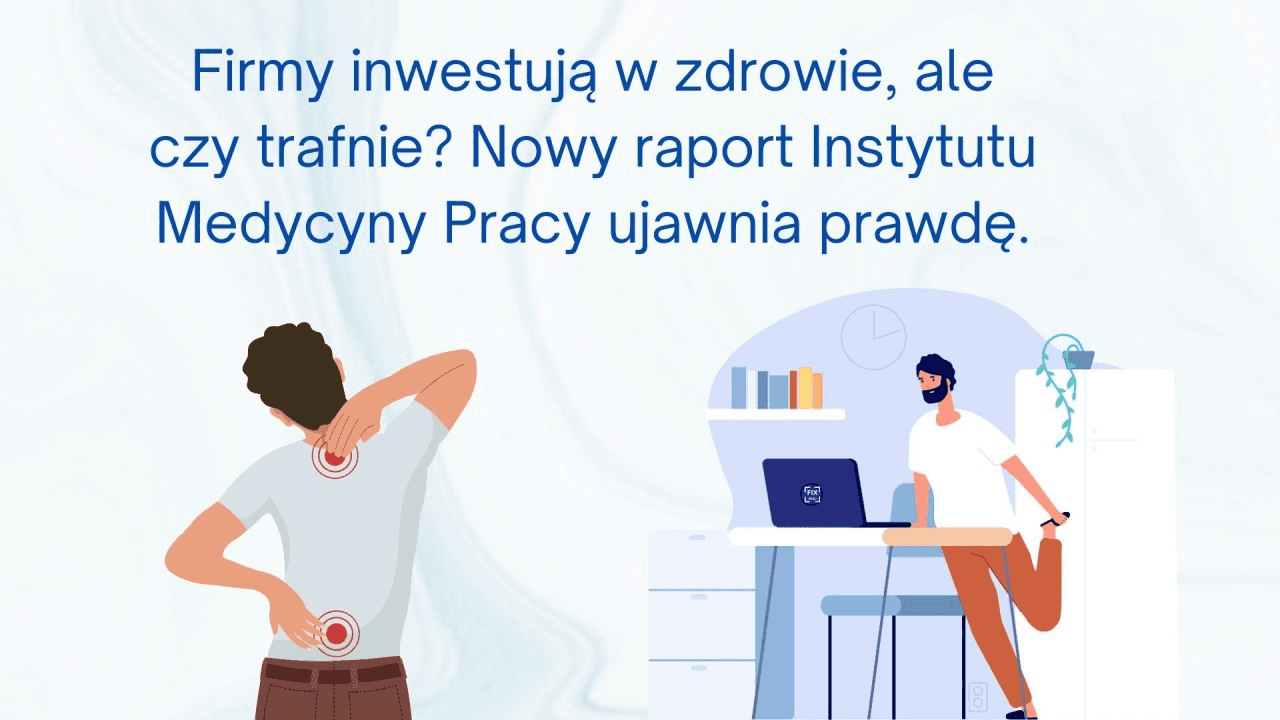
Companies invest in health, but is it wisely? New report from the Institute of Occupational Medicine
The latest report "Traffic in the Interest of Health" by the Prof. J. Nofer Institute of Occupational Medicine sheds light on how Polish companies (1,032 organizations surveyed) approach the well-being of their employees. The conclusions? They are fascinating and thought-provoking.
The latest report "Movement in Health Interests" by the Nofer Institute of Occupational Medicine sheds light on how Polish companies (1,032 organizations surveyed) approach their employees' well-being. The findings? They are fascinating and thought-provoking.
The full version of the report is available here: See
On the one hand – bravo! 👏 Most companies undertake voluntary health-promoting activities. On the other hand – a deeper analysis reveals that these are often superficial actions, based on intuition rather than real data and needs.
As someone who deals with employee health daily, I have analyzed this document. Here are the key conclusions and what they mean for your organization.
Problem #1: Passivity and lack of strategy
The report shows that health promotion in companies is most often of a passive nature. What does that mean?
58% of companies offer amenities for cyclists.
29% subsidize sports memberships.
These are great initiatives, but they are like providing a fishing rod without instructions on how to fish. The problem is that more than half of the companies (52%) offering sports cards do not monitor at all whether employees use them!
Even worse, these actions rarely result from a strategy:
Only 8% of companies analyze data on employees' health status.
Merely 12% gather information on employees' health expectations.
Only 5% have a written and thought-out health strategy.
Conclusion: Companies invest, but often "blindly," not knowing whether their actions are effective and address real issues.
Problem #2: Silent office crisis – pain and effects of sedentary work
The report indicates that in the surveyed companies, as many as 65% of employees work mainly in a seated position. This is an army of people exposed to back pain, neck stiffness, and decreased productivity. It's a real hidden cost of office work.
And how do companies respond? Unfortunately, poorly.
Only 6% offer physiotherapy sessions or massages on company premises.
Just 3% organize joint exercises during work hours.
This shows a huge gap. We provide employees with gym cards, which they often don't have time to use, ignoring the issue that grows during 8 hours at the desk.
How to address these challenges? Time for active and measurable solutions!
The report calls for a change in approach – from passive to active, from intuitive to data-driven. Instead of another benefit that becomes just a line item in the budget, we need solutions that work here and now.
Direct intervention in the office: massage and physiotherapy Instead of waiting for employees to find help themselves, offer it at the workplace. Our solution – office massage (www.masazbiurowy.com) – is a direct response to the needs of people working in a seated position. Short, regular in-office sessions reduce pain, decrease stress, and genuinely improve well-being. It's a benefit that employees feel immediately.
Learn more
Odkryj więcej z najnowszych postów.