Published: Jun 20, 2025
Companies invest in health, but are they doing it right? New report from the Institute of Occupational Medicine
FIXme · 3 min read
The latest report “Movement in the interest of health” by the Nofer Institute of Occupational Medicine sheds light on how Polish companies (1,032 organizations surveyed) approach the well-being of their employees. Conclusions? They are fascinating and thought-provoking. The latest report “Movement in the interest of health” by the Nofer Institute of Occupational Medicine sheds light on how Polish companies (1,032 organizations surveyed) approach the well-being of their employees. Conclusions? They are fascinating and thought-provoking. The full report can be found here: View On the one hand – bravo! 👏 Most companies take voluntary pro-health measures. On the other hand – a deeper analysis shows that these are often superficial actions, based on intuition rather than real data and needs. As someone who deals with employee health on a daily basis, I analyzed this document. Here are the key findings and what they mean for your organization.
Problem #1: Passivity and lack of strategy
The report shows that health promotion in companies is mostly passive. What does that mean?
- 58% of companies offer facilities for cyclists.
- 29% subsidize sports subscriptions. These are great initiatives, but they are like providing a fishing rod without fishing instructions. The problem is that more than half of the companies (52%) offering sports cards do not monitor at all whether employees use them! Worse still, these actions rarely stem from a strategy:
- Only 8% of companies analyze data on the health status of their staff.
- Only 12% collect information about employees' health expectations.
- Only 5% have a written, well-thought-out health strategy. Conclusion: Companies invest, but often “blindly”, without knowing whether their actions are effective and whether they respond to real problems.
Problem #2: Silent crisis in offices – pain and the effects of sedentary work
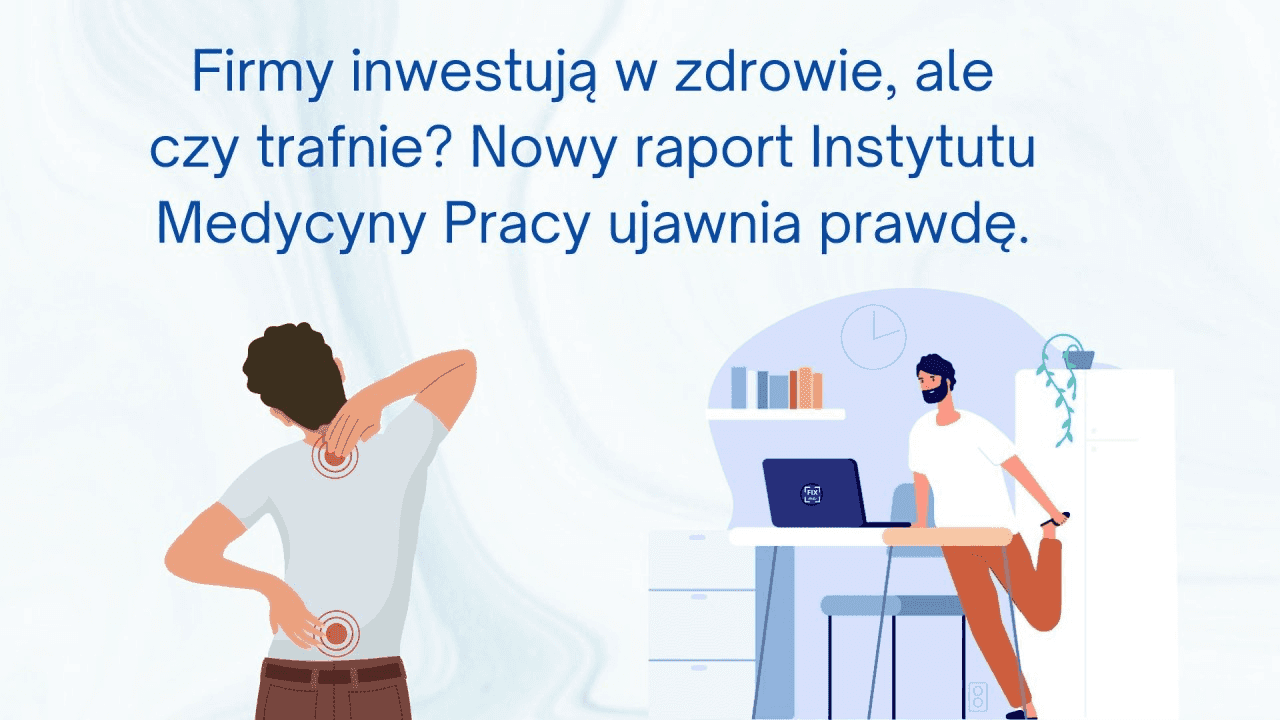
The report indicates that in the surveyed companies, as many as 65% of employees work mainly in a sitting position. That is an army of people exposed to back pain, neck pain, stiffness, and a drop in productivity. This is the real, hidden cost of office work. And how do companies respond to this? Unfortunately, poorly.
- Only 6% of companies offer physiotherapy treatments or massages on company premises.
- Only 3% organize group exercises during work hours. This shows a huge gap. We give employees gym cards for a gym they often don't have time to go to, ignoring the problem that builds up over 8 hours at a desk.
How to respond to these challenges? Time for active and measurable solutions!
The report is a call to change the approach – from passive to active, from intuitive to data-driven. Instead of another benefit that becomes just a line item in the budget, we need solutions that work here and now. Direct intervention in the office: massage and physiotherapy Instead of waiting for the employee to find help on their own, offer it in the workplace. Our solution – office massage (www.masazbiurowy.com) – is a direct answer to the needs of people working in a seated position. Short, regular sessions in the office reduce pain, decrease stress, and genuinely improve well-being. This is a benefit that employees feel immediately.