Published: Sep 14, 2026
5 minutes of movement at work that changes your whole day
I know this from the stories of hundreds of desk workers: it's 2:00 PM, your neck is stiff, your shoulders have crept up to your ears, and your brain is running at half power. You reach for another coffee, even though your body is actually asking for something else. Movement. The good news is that you don't need a gym or a change of clothes. All it takes is 5 minutes of movement at work, done right here and now, at your own desk. In this article, I give you a ready-made, step-by-step routine. You open it, do it, and return to your tasks with a clearer head. This isn't a general guide to breaks, it's a specific, 5-minute active break you can do on the spot.

Małgorzata Świderska · 5 min read
Why 5 minutes is enough
Put simply: your body doesn't need an hour to feel the difference. It needs consistency and short breaks from stillness.
A review of studies published in PLOS ONE (Albulescu et al., 2022) showed that micro-breaks—stepping away from a task for 10 minutes or less—are associated with less fatigue and higher energy to act (the analysis covered 22 trials, totaling 2,335 people). That's exactly the timeframe our 5 minutes falls into.
What happens to your back? In a study published in the Journal of Clinical Medicine (2024), people who took a short, roughly 2-minute movement session every 30 minutes (walking, forward bend, trunk rotations, neck movements) experienced measurably less back strain than those who sat without breaks. Movement simply releases the tension that builds up during stillness.
What about walking? Even light walking. An analysis in the journal Sports Medicine (Buffey et al., 2022) showed that short bouts of light walking lasting 2 to 5 minutes help maintain more stable post-meal blood sugar levels compared to prolonged sitting. The World Health Organization's 2020 guidelines point in the same direction: any amount of movement is better than none, and time spent sedentary is worth replacing with activity of any intensity.
Five minutes is not a compromise. It's a realistic dose that you can repeat several times a day. And it's this repeatability that does the job.
Your routine: 5 minutes, step by step
Set the timer for 5 minutes, put your phone away, push your chair back where it belongs. Let's go.
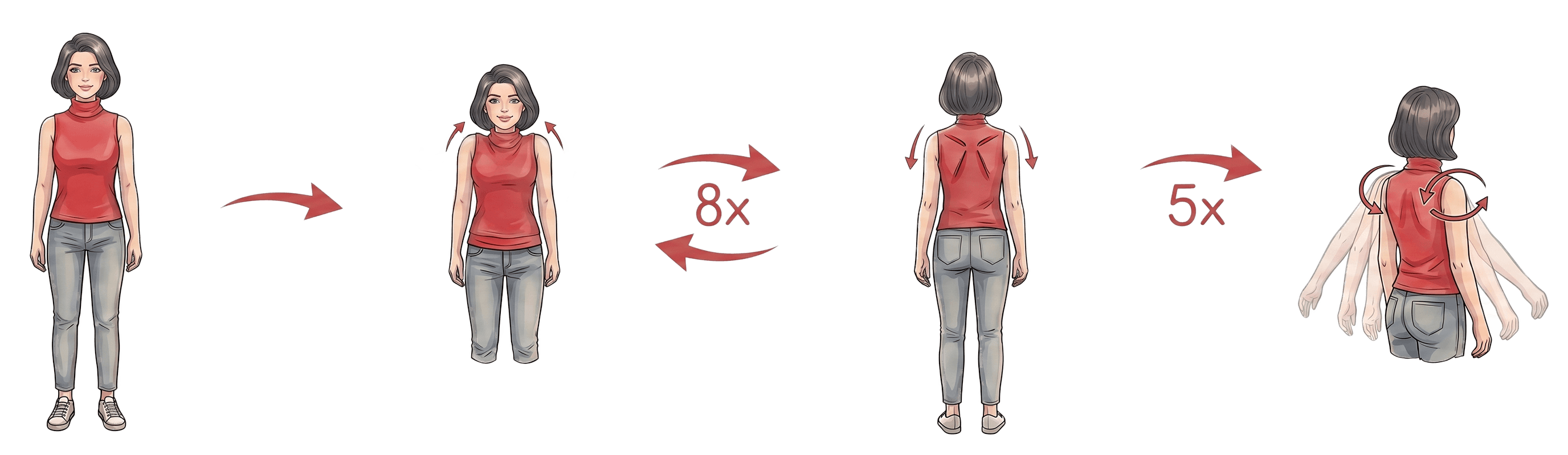
Minute 1: Shoulders down (why and how)
Why: At a desk, your shoulders creep up to your ears and stay there. You relax your shoulder girdle and the muscles that hold tension for you.
How: Sit or stand up straight. Raise both shoulders toward your ears, count to three, and then drop them distinctly downward, as if you wanted to tuck your shoulder blades into your back pockets. Repeat 8 times. Then make 5 slow backward circles with your shoulders. Breathe calmly.
Minute 2: A neck that catches its breath
Why: The neck holds the weight of your head all day long. Gentle movements through a full range of motion restore its ease.
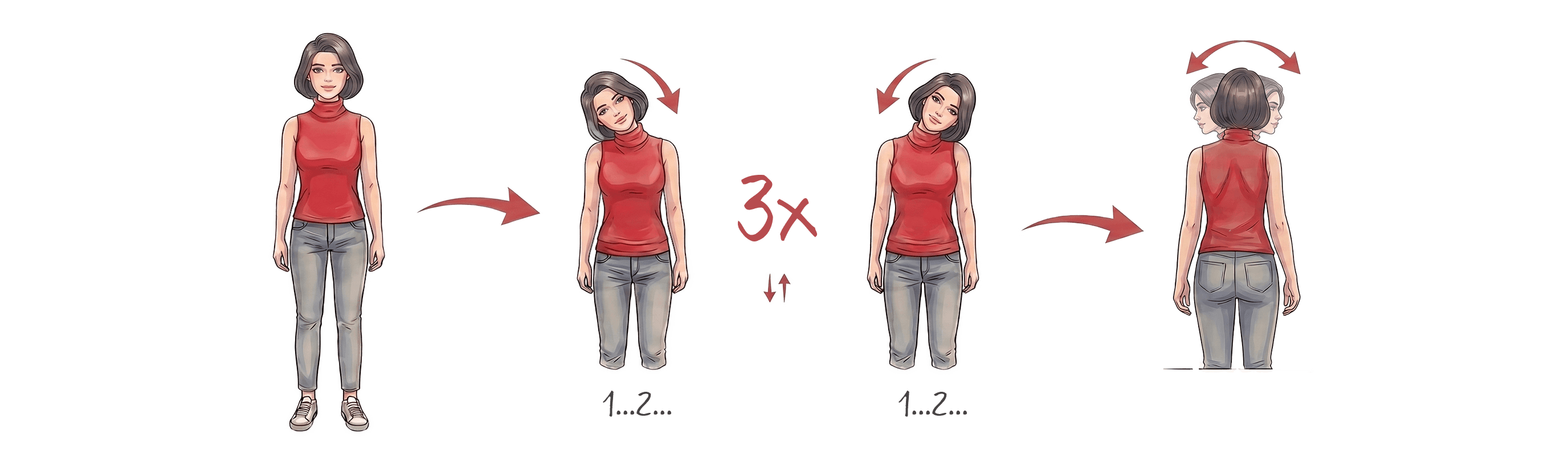
How: Slowly lower your ear toward your right shoulder, hold for two breaths, return to the center, and repeat on the left side. Do 3 repetitions per side. Then gently turn your head to the right, as if looking behind you, and to the left. Movements should be smooth, without jerking and without pain.
Minute 3: The spine wakes up
Why: The spine loves movement in various directions. Rotation and a gentle forward bend mobilize the section that suffers most from sitting.
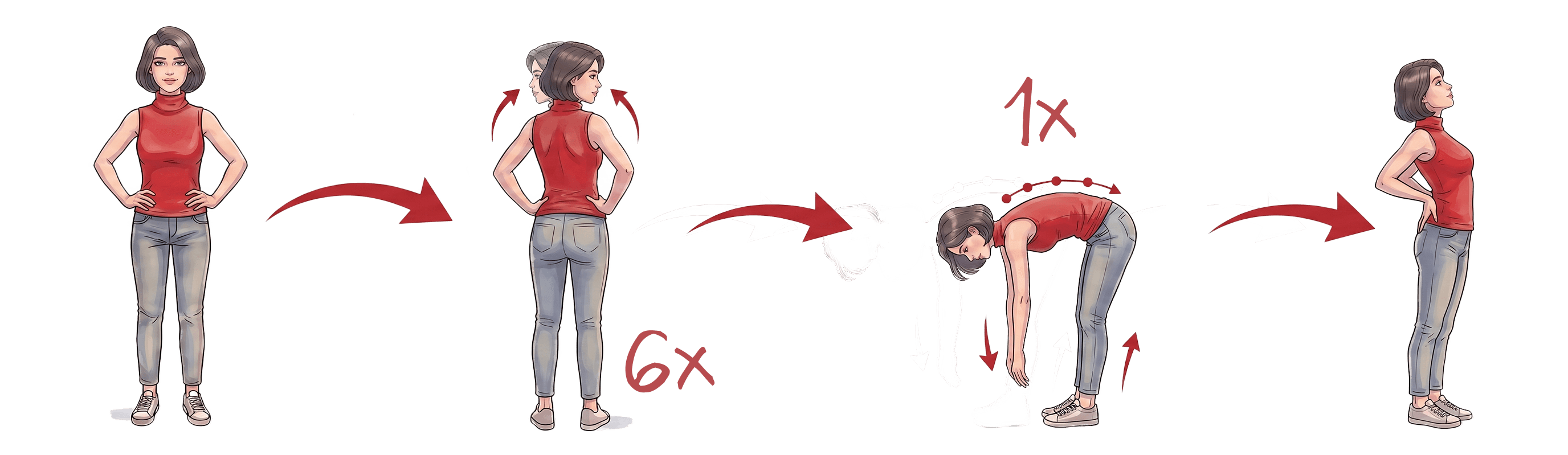
How: Stand with feet slightly apart, hands on your hips. Perform 6 smooth torso twists to the right and left, following the movement with your gaze. Then do a gentle forward bend, let your arms dangle for two breaths, and slowly roll back up, vertebra by vertebra. Finally, a gentle extension: hands on your lower back, lean slightly backward.
Minute 4: Hips and a short walk
Why: Sitting makes your hips stiff, yet they power every step you take. You open them up and immediately add a walk, which has the strongest evidence backing it.
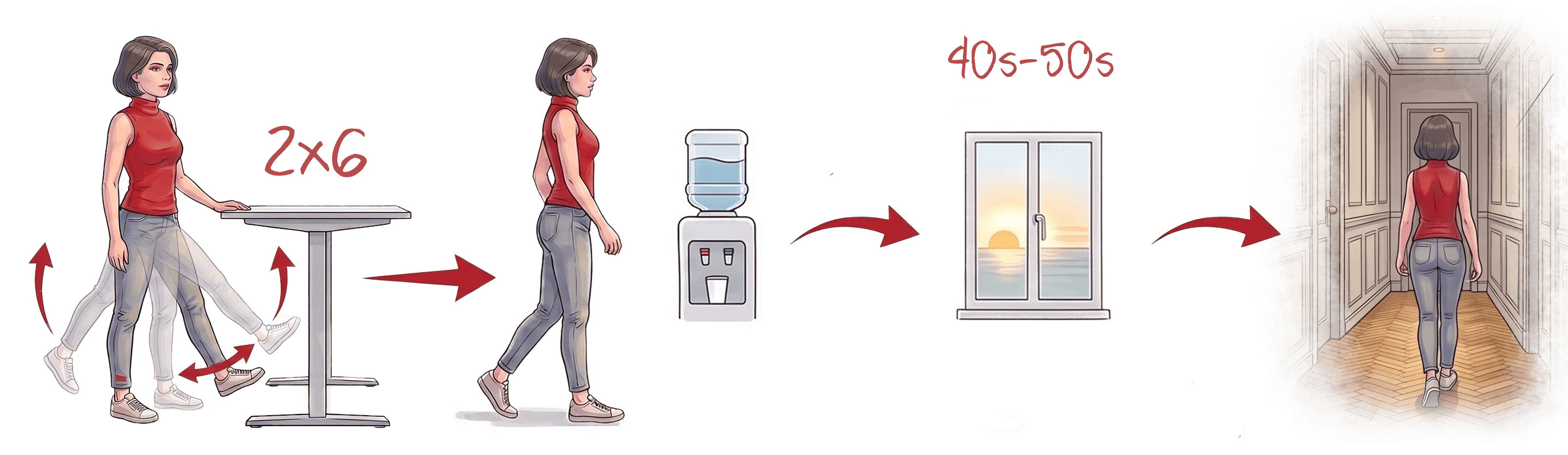
How: Stand by your desk, hold on to the desktop for balance. Perform 6 gentle leg swings forward and backward with one leg, then switch legs. Then simply take a walk: to the kitchen for water, to the window, down the hallway and back. The goal is movement, not speed. Those 40 to 50 seconds of walking are your mini dose of walking.
Minute 5: Rest for the eyes and a reset
Why: Your eyes stare at the same distance for hours. A brief reset reduces eye fatigue and concludes the break with calm.
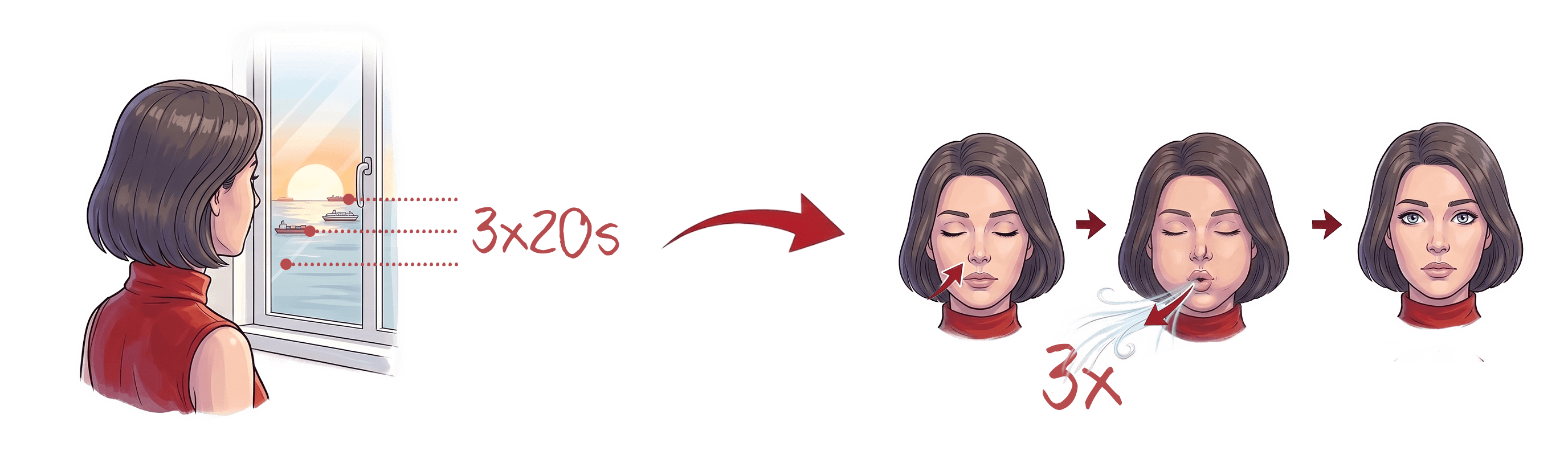
How: Stand by the window and find a point far on the horizon. Look at it for 20 seconds, then shift your gaze to something close by and far away again, several times. Finally, close your eyes, take three deep breaths: inhale through your nose, longer exhale through your mouth. Open your eyes. That's it. Back to the desk.
My one human addition: on the first day, you'll feel a bit strange doing shoulder circles in an open space. On the second day, someone will join in. By the third day, it's already your little ritual. That's really how it works.

FAQ
- Does 5 minutes really make a difference if I sit for 8 hours?
Yes, provided that you repeat this break. Research on micro-breaks shows effects even with brief departures from a task (10 minutes or less), and research on short walks shows effects with 2 to 5 minutes of movement. The secret lies in frequency, not in the duration of a single session. Do these 5 minutes two or three times a day.
- When during the day is the best time to take this active break?
Ideally when you feel your energy dropping, most often in the late morning and early afternoon. Another great time is shortly after a meal, because that's when light walking benefits the body most. If you prefer a set schedule rather than waiting for cues from your body, set a reminder every 90 minutes.
- Will this replace my exercise after work?
Don't treat this as a substitute, but as a complement. Short breaks release tension during the day, while your regular activity outside of work builds long-term fitness. One supports the other. Instead of choosing, combine both.
Try it with FIXme
At FIXme, our virtual physiotherapist guides you through such sessions step by step, tailors the movements to you, and reminds you to take a break at the right time. See how it works: FIXme - Try 14 days for free