Published: Nov 12, 2026
A bag on one shoulder and a slippery sidewalk: what really happens to your body on the way to work
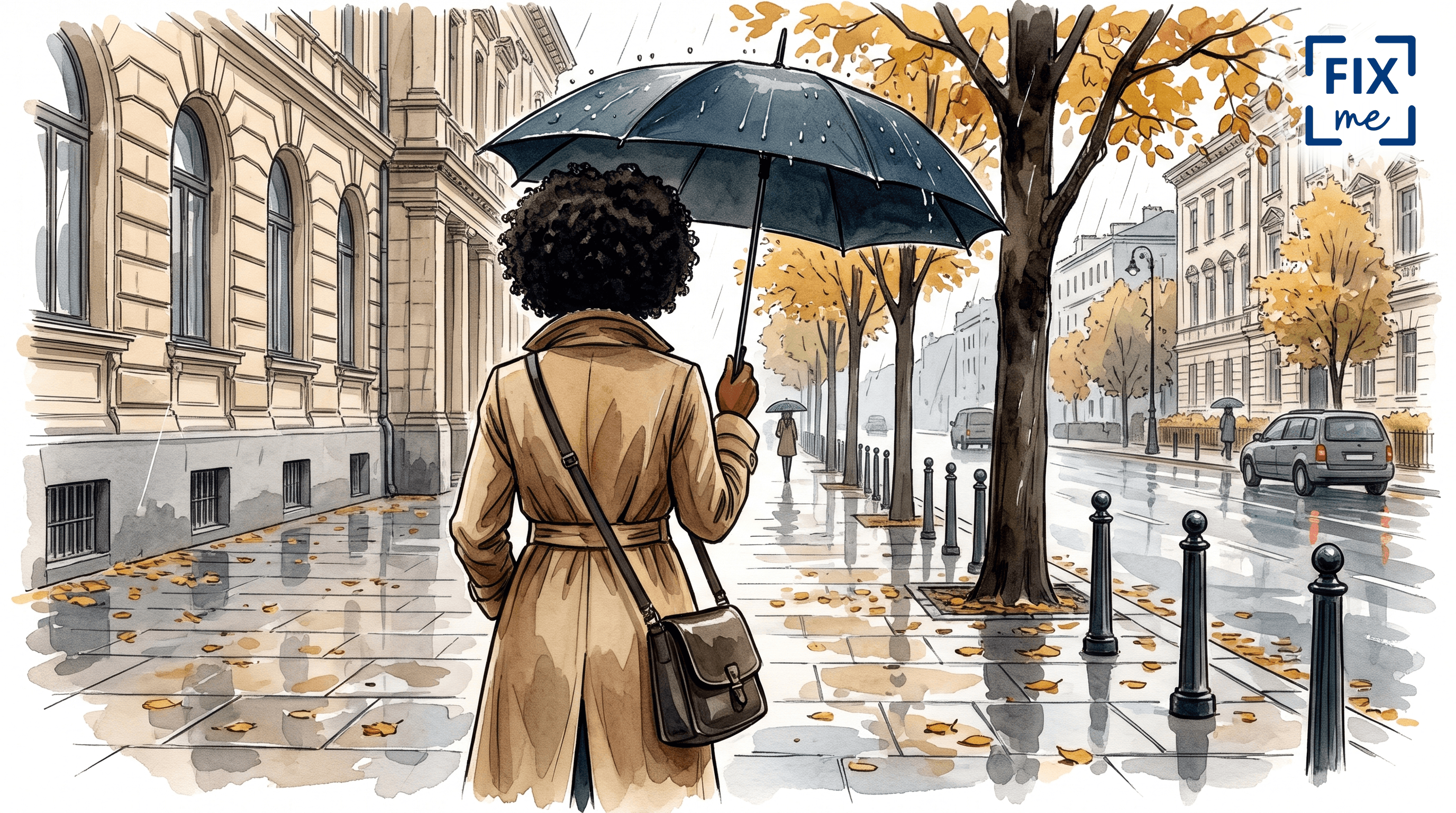
It's 7:40 AM, a bag on one shoulder, packed with a laptop, charger, and lunch box, with an umbrella in your other hand. The sidewalk glistens after overnight rain, so you step more carefully than usual. After twenty minutes, you sit down at your desk and feel as though one shoulder is hanging higher than the other. Let's look at what really happens to your body during that commute, and what is merely fear-mongering.
Małgorzata Świderska · 6 min read
A bag on one shoulder: what the research shows

I'll start with an experiment that, despite its age, remains one of the few on the topic (Phonpichit et al., Work, 2016). Thirteen healthy women walked with a handbag on one side of their body (the authors studied carrying a handbag, not a backpack) weighing 5%, 7%, and 10% of their body weight. The upper trapezius and erector spinae worked unevenly on both sides of the body, and with a heavier bag, the center of foot pressure shifted toward the load. The participants reported discomfort in the upper right trapezius muscle and in the finger flexors of the right hand.
The most interesting part, however, is what wasn't found. Spinal curvatures didn't change. The muscles worked asymmetrically, but the spine didn't "warp" under the weight of the bag.
More recent data concerns gait. In a study from Kyoto (Suzuki et al., Scientific Reports, 2025), 26 young, healthy individuals marched for 10 minutes without luggage, with a backpack, with a shoulder bag, and with a crossbody bag. Each bag contained the same load: 3.3 kg. Bags loading one side increased gait asymmetry, most noticeably during toe-off and swing speed. Step length changed very little. The bag worn diagonally across the body didn't fare any better at all. In some parameters, the asymmetry was even greatest with it.

What we don't know and why it's reassuring
I haven't found any studies showing that carrying a bag on the shoulder causes back pain or scoliosis in adults. The experiments mentioned above lasted minutes, not years, and involved small groups. You might come across the "maximum 10% of body weight" rule. The authors of the study with 13 women also mention it in their conclusions, but that is their extrapolation, not a measured threshold.
It's a similar story with a heavy coat. The only source I found describes heavy, multi-layered winter clothing worn by soldiers (for Arctic operations, among other things), which limits range of motion in the joints (Schafer et al., Journal of Applied Physiology, 2024). I'm not applying that to a wool coat on a tram, because I found no studies on ordinary coats.

Slippery sidewalk: the body switches to caution mode
A classic experiment from Rome (Cappellini et al., Journal of Neurophysiology, 2010) showed what we do on very slippery surfaces. Steps become shorter, the head stabilizes in space, and the arms and trunk move significantly more than usual. The legs "stiffen," and the activity of spinal cord neural cells controlling the muscles roughly doubles. Stabilization of the hips and center of mass improved with practice.
This isn't a bodily error; it's a protective mechanism. A 2023 computer simulation (Koo et al., Scientific Reports) suggests that such co-contraction of leg muscles reduces the likelihood of falling on a slippery surface. It's a model, not a human study, but it fits the picture.
From my perspective, this explains why, after walking in the rain, many people sit down at their desks feeling "tensed up." I found no studies on neck and shoulder tension after such a walk.
Falls have a real cost. In Sweden between 2015 and 2022, 50,500 fractures were recorded following slips on ice or snow, accounting for 9% of all fractures in the registry (Ivdal et al., Acta Orthopaedica, 2025). The most commonly injured were the wrist (34%) and ankle (18%), and nearly 70% of fractures occurred in women. These are winter, Scandinavian data. I found no figures on wet leaves.

How to carry a work bag to relieve your shoulders
Most of these tips stem from my daily clinical practice with patients, not from scientific studies
- Switch shoulders. At every bus stop or traffic light, move the bag to the other side.
- A backpack on both shoulders distributes weight symmetrically. A crossbody bag isn't an obvious solution here, as the Kyoto study showed.
- Lighten your bag. In the evening, take out what you won't need tomorrow.
- Choose the right shoes for slippery days. The authors of the Swedish study highlight slip-resistant footwear as one of the ways to prevent injuries.
3 minutes after arriving at the office
On your way, one side of your body worked harder, and the whole body was in caution mode. That's why, upon arriving at the office, I suggest a short, symmetrical break. In a meta-analysis of 19 randomized trials involving 2,732 sedentary workers (Yaghoubitajani et al., Scientific Reports, 2026), brief desk exercises reduced neck and shoulder pain. The certainty of evidence for combined neck and shoulder pain was rated as moderate, and the authors note that the overall results are affected by substantial differences between studies and potential publication bias. I found no studies on people right after their commute, so treat this as a sensible start to the day rather than damage repair.
The following three movements come from the FIXme exercise library. Move slowly, within a range free of sharp discomfort.
1. Backward arm circles
Sit upright with your feet on the floor. Raise your arms out to the sides and draw large backward circles with them. Ten repetitions, slowly and with control.
2. Side bend
Sit upright, feet hip-width apart. Raise one arm overhead, rest the other hand on your hip, and bend your torso toward that hand. Hold for a few seconds and return. Twelve alternating repetitions, or six per side. Keep your glutes planted on the chair.
3. Torso rotations
Move to the edge of the chair, back away from the backrest. Rotate your torso to one side so that your hand reaches the backrest, and return. Ten alternating repetitions. Keep your shoulders down away from your ears.
You'll find similar movements in the "Mobile Shoulders" program.

When to back off and seek advice
Stop exercising and contact a specialist if you experience chest tightness or discomfort, dizziness, spots before your eyes, sudden shortness of breath, heart palpitations, or sharp pain during movement. The same applies to numbness or tingling in the arm that doesn't subside after changing positions.
Also back off if you have a fever or infection, after an injury (including a slip and fall on the sidewalk) or procedure without clearance from your attending physician, and if you are being treated for a chronic heart or circulatory condition and haven't confirmed that such movement is safe for you.

FAQ
- Is carrying a bag on one shoulder harmful?
In short-term experiments, carrying a bag on one side of the body is associated with asymmetrical shoulder and back muscle activity, as well as changes in gait. However, in a study of 13 women carrying a handbag on one side, spinal curvatures did not change, and studies on long-term effects in adults are lacking.
- How much can a work bag weigh?
There is no measured, safe limit. The "10% of body weight" rule is an arbitrary guideline that no study has confirmed through measurement. A lighter bag and frequent shoulder switching are simply sensible habits.
- Which is better: a crossbody bag or a backpack?
In a 2025 study, bags loading one side—including those worn crossbody—increased gait asymmetry. A backpack worn on both shoulders distributes the weight symmetrically.
- Why do I walk so stiffly on a slippery sidewalk?
It's a natural protective response. The body switches into a mode that keeps its center of gravity over the feet: steps shorten, and the legs stiffen.
The commute to work is over, but your shoulders often still remember it. The FIXme app will remind you to take a short break for your shoulders and torso. A virtual physical therapist guides you through the movements, while the camera checks your form and counts repetitions. See how it works: sign up
Learn more
Discover more from the latest posts.